Feeder
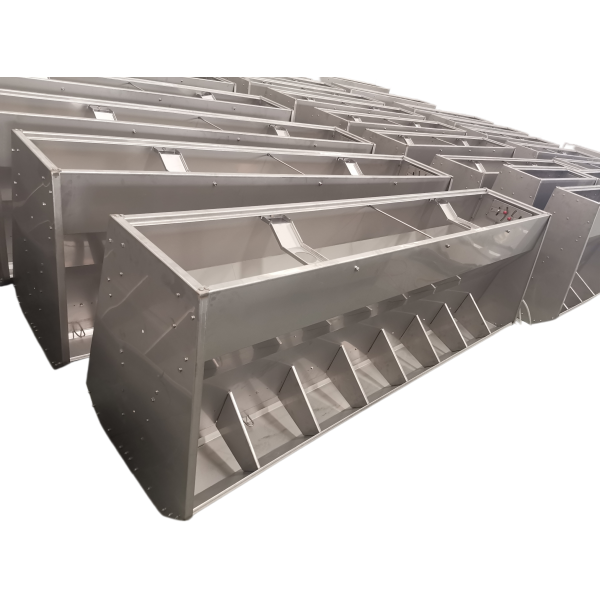
Swine feeders are primarily categorized into two types: dry-wet feeders (suitable for powder or pellet feed) and liquid feeding systems.
1. Dry-Wet Feeders
These are currently the most prevalent products in commercial pig farms. They are characterized by a feed hopper positioned at the top, with a water bowl or wet-mixing trough located underneath.
Key Specifications:
1. Capacity: Typically ranges from 75 kg to 110 kg (approximately 100 L), sufficient to meet the feeding requirements of 30 to 50 finishing pigs.
2. Material: The hopper body is predominantly constructed from PP or PE (polyethylene) plastic for corrosion resistance, while the base trough *must* be made of 304 stainless steel (typically 1.5 mm to 2.0 mm thick) to ensure durability against rooting and corrosion.
3. Dimensions: Taking the 100 L model as an example, the hopper diameter is approximately 450–660 mm, the base trough measures roughly 700 mm x 400 mm, and the total height is approximately 1.1 meters.
1. Water-Saving & Feed Intake Boosting: When pigs nudge the mechanism, feed is automatically dispensed and mixed with water to form a wet mash. This enhances palatability, increases feed intake by up to 20%, and allows for market-ready finishing 7 to 10 days earlier than usual.
2. Feed Conservation: The specialized design of the feed outlet prevents pigs from rooting through and wasting feed; compared to traditional concrete troughs, this results in a 5% to 10% reduction in feed wastage.
Operation: Equipped with a medication port and a rodent-proof lid for convenient feed replenishment.
Target Users: Nursery pigs (post-weaning) and finishing pigs.
2. Intelligent Liquid Feeding Systems
Product Features:
Principle: Powdered feed is mixed with water in precise proportions to create a liquid mash (slurry), which is then pumped through a pipeline system to the feeding troughs.
Advantages: Offers extremely high digestibility and nutrient absorption rates, while producing virtually no airborne dust. These systems are typically computer-controlled, allowing for automated, time-based, and quantitative feeding; advanced systems can even utilize sensor technology to identify individual pigs for precision feeding.
Performance: Significantly reduces the incidence of diarrhea (loose stools) in nursery pigs, while keeping feed wastage rates controlled within 2%.